
politicsResolves Jun 16, 2026
Forecast probability
7%
#Trump #Trump Presidency #Politics
Follow forecasts for leaders, legislation, institutions, policy shifts, public approval, and government decisions.
Discovery Mode
Editorial + Probability
Browse indexable forecasts, topical tags, and category-specific context without exchange-style charts or trading noise.
96 matching forecasts
96 matching forecasts from politics.
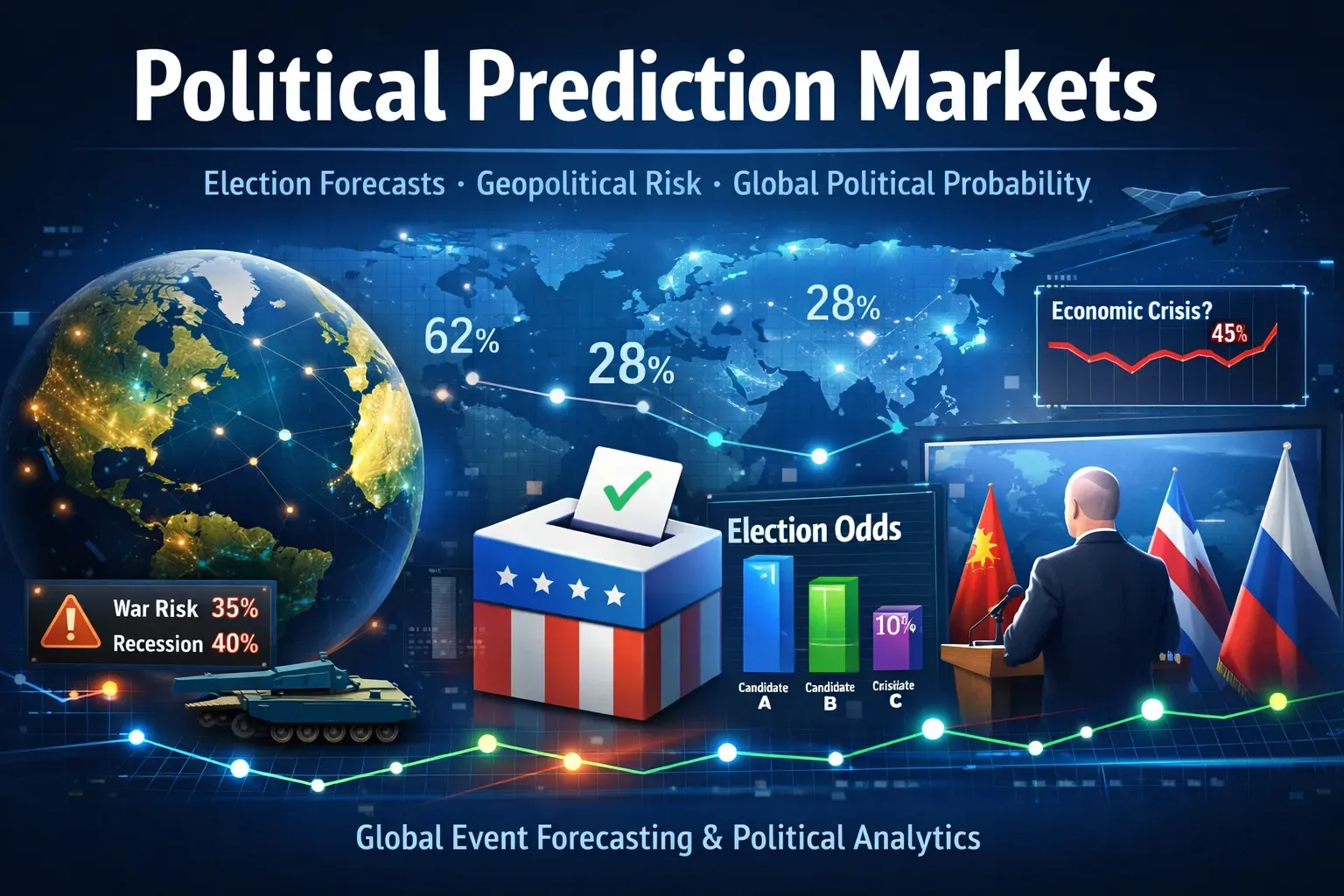
Political events shape the global economy, financial markets, international relations, and public policy. Understanding political probabilities—such as election outcomes, geopolitical conflicts, and leadership changes—has become essential for analysts, investors, journalists, and researchers.
Political prediction markets transform collective intelligence into measurable probabilities for future political events. By aggregating information from thousands of participants, these markets produce real-time forecasts for elections, geopolitical crises, economic policy decisions, and leadership transitions.
Unlike traditional polling or expert commentary, prediction markets use market incentives and probability pricing to estimate the likelihood of real-world outcomes.
These systems now forecast events including:
Prediction markets therefore represent one of the most powerful tools available for global political forecasting and probability analysis.
A political prediction market is a marketplace where participants trade contracts representing the probability that a political event will occur.
Each contract represents a future political outcome, such as:
The market price of each contract reflects the collective estimate of probability.
| Event | Market Price | Implied Probability |
|---|---|---|
| Candidate A wins election | $0.62 | 62% |
| Candidate B wins election | $0.34 | 34% |
| Other candidates | $0.04 | 4% |
This price discovery mechanism converts crowd knowledge into political probability forecasts.
Prediction markets are widely used to estimate:
Traditional political forecasting relies on polls, expert panels, or statistical models. Prediction markets enhance these methods by incorporating real financial incentives and distributed information networks.
Key advantages include:
| Feature | Benefit |
|---|---|
| Collective intelligence | Aggregates information from thousands of participants |
| Real-time probability updates | Markets react instantly to breaking news |
| Incentive alignment | Traders profit from accurate predictions |
| Transparency | Market prices clearly represent probabilities |
| Continuous forecasting | Predictions update dynamically |
Because of these properties, prediction markets often produce more accurate forecasts than traditional polling alone. You can also see how these techniques are applied in sports prediction markets or cryptocurrency price forecasting.
One of the most widely used applications of prediction markets is election forecasting.
Markets exist for elections around the world, allowing analysts to estimate:
| Candidate | Market Probability |
|---|---|
| Candidate A | 48% |
| Candidate B | 41% |
| Candidate C | 8% |
| Other | 3% |
These probabilities continuously update as new information becomes available, including:
Search interest for "who will win the next election" and "election probability forecast" has grown dramatically in recent years.
Prediction markets provide a data-driven way to analyze these questions.
Typical election prediction metrics include:
These indicators allow analysts to estimate the probability of election victory long before voting occurs.
Political prediction markets extend beyond elections to forecast major geopolitical events.
Common market topics include:
| Event | Estimated Probability |
|---|---|
| Major geopolitical crisis | 28% |
| Global recession | 35% |
| Government collapse in major economy | 11% |
| Military conflict escalation | 19% |
These markets allow analysts to evaluate global political risk probabilities.
Another rapidly growing category in political prediction markets involves conflict probability forecasting.
Markets frequently analyze:
Example forecast table:
| Scenario | Estimated Probability |
|---|---|
| Regional conflict escalation | 23% |
| Major international military conflict | 14% |
| Nuclear conflict scenario | <2% |
| Large-scale geopolitical crisis | 19% |
These probability estimates are often monitored by:
Prediction markets also forecast future political leaders.
These markets answer questions such as:
| Candidate | Probability |
|---|---|
| Candidate A | 52% |
| Candidate B | 37% |
| Candidate C | 9% |
| Other | 2% |
Leadership prediction markets are especially active during:
Political forecasting markets exist for many national elections and leadership transitions.
Forecasting topics include:
More analysis:
Japan markets are frequently analyzed:
More analysis:
South Korea prediction markets often track:
More analysis:
Indonesia's rapidly growing forecasting community analyzes:
More analysis:
New Zealand prediction markets track:
More analysis:
Prediction markets and polling both estimate political outcomes, but they function differently.
| Feature | Prediction Markets | Opinion Polls |
|---|---|---|
| Forecast method | Market pricing | Survey responses |
| Updates | Continuous | Periodic |
| Incentives | Financial | None |
| Bias correction | Market trading | Sampling methods |
| Real-time information | High | Limited |
Because traders incorporate new information instantly, prediction markets often adjust faster than polls.
Political events strongly influence financial and economic outcomes.
Prediction markets therefore analyze interactions between:
Example economic forecast:
| Event | Estimated Probability |
|---|---|
| Global recession | 34% |
| Interest rate cuts | 57% |
| Economic crisis | 18% |
Political forecasting therefore intersects with financial forecasting and macroeconomic analysis.
Political prediction markets are part of a broader ecosystem of event forecasting platforms.
Related categories include:
Forecast outcomes such as World Cup winners and tournament probabilities. See: Sports
Estimate Bitcoin price probabilities, crypto bull runs, and market cycles. See: Crypto Prediction Markets
Together these forecasting categories create a global prediction ecosystem covering politics, economics, sports, and technology events.
Professional forecasters often combine several analytical approaches:
Using polling data, economic indicators, and historical election results.
Analyzing how probability prices change after major political news.
Estimating probabilities for multiple geopolitical outcomes.
Identifying events before markets adjust.
Political forecasting platforms are evolving rapidly as new technologies emerge.
Future developments may include:
As data availability increases, prediction markets are expected to become a central tool for analyzing political and geopolitical risk worldwide.
A political prediction market is a platform where users trade contracts representing the probability of political events such as elections, leadership changes, or geopolitical conflicts.
Many studies suggest prediction markets can outperform polls because they aggregate information from many participants and update probabilities continuously.
Prediction markets analyze many types of events, including:
Election probabilities are derived from the market price of contracts representing each possible outcome.
Example:
Market price: $0.65 Implied probability: 65%
Political prediction markets represent one of the most powerful tools for forecasting global political events, elections, and geopolitical risks.
By combining collective intelligence, probability modeling, and market incentives, these platforms provide dynamic estimates for:
As forecasting technology continues to evolve, prediction markets will become an increasingly important framework for understanding the future of world politics.
Continue exploring adjacent forecasting topics.
Track races, candidates, parties, referendums, polling shifts, turnout, and electoral outcomes around the world.
Monitor forecasts for conflict risk, alliances, diplomacy, sanctions, security policy, and international power shifts.
Follow forecasts for inflation, labor markets, growth, central banks, recession risk, and macroeconomic shifts.