
sportsResolves May 30, 2026
Forecast probability
43%
#Sports #NBA #NBA Finals
Track political events, crypto milestones, elections, sports, finance, technology, weather, and global trends using prediction-driven forecasting.

Compact forecast cards built around the fields PredStack can actually index: title, category, tags, probability, and dates.
Discover forecasts by topic, from politics and macro risk to sports, AI, weather, and culture.
Government, leaders, policy, and public power.
Digital assets, protocols, ETFs, and adoption.
Tournament outcomes, teams, and season forecasts.
National races, parties, candidates, and referendums.
Rates, funds, public companies, and macro signals.
Inflation, labor, growth, and central banks.
AI, software, chips, platforms, and releases.
Climate, storms, temperatures, and seasonal events.
Conflict risk, alliances, diplomacy, and security.
Teams, tournaments, titles, and regional form.
Awards, media, public attention, and cultural events.
Editorial-style event views for long-range questions and high-signal global topics.
This market is to predict the winner of the 2025–26 NBA Finals.
This market will resolve to “Yes” if Iran and the United states agree to a permanent peace deal by the specified date, 11:59 PM ET. Otherwise, this market will resolve to “No”. A permanent peace deal refers to any agreement which explicitly indicates that military hostilities between the United States and Iran have ended or will permanently cease, or uses equivalent language clearly signaling a lasting end to military hostilities between the United States and Iran. Agreements that are explicitly temporary or which do not include a definitive agreement to end military hostilities between the US and Iran on a lasting basis (e.g. a temporary extension of the two-week ceasefire agreement announced on April 7, 2026), will not qualify. A qualifying agreement will be considered to have been established if either of the following conditions are met: - The United States and Iran each sign or formally adopt a written agreement (e.g. a treaty or multi-point agreement) which meets the above criteria. - Both the governments of the United States and Iran provide clear public confirmation that a qualifying agreement has been definitively established. Negotiations, statements of progress, or other statements which do not constitute a definitive announcement that a qualifying agreement has been reached will not count. The primary resolution source for this market will be official information from the governments of the United States and Iran; however, a consensus of credible reporting may also be used.
On April 12, 2026, President Donald Trump announced that the United States will blockade the Strait of Hormuz. You can read more about that here: https://www.nbcnews.com/world/iran/live-blog/live-updates-us-iran-fail-reach-deal-peace-talks-day-negotiations-rcna315918. This market will resolve to "Yes" if President Trump, the US government, or the US military publicly and officially announces the end of the United States blockade of the Strait of Hormuz by the specified date, 11:59 PM ET. Otherwise, this market will resolve to "No." Qualifying statements must clearly and explicitly indicate that the United States has lifted, ended, or will lift or end its blockade of the Strait of Hormuz on a specified date or use equivalently definitive language unambiguously signaling that such blockade has ceased or is set to cease on a specified date (e.g., statements unambiguously indicating that US naval activity in the relevant area has ceased will qualify). Statements that merely describe actions inconsistent with the blockade (e.g., "Iran resumed shipping through the Strait of Hormuz") without explicitly indicating the blockade as lifted will not alone suffice. Informal announcements, statements from unnamed sources, or leaks do not qualify. Written public statements from Donald Trump (e.g., posts from his personal Truth Social account) will qualify. Videos posted on his social media accounts will also qualify for a "Yes" resolution. The primary resolution source for this market will be official statements from the US government and/or its official representatives; however, a consensus of credible reporting may also be used. Note: this market will resolve solely based on whether a qualifying announcement is made within the specified timeframe. Whether the blockade is effectively enforced or whether maritime traffic resumes absent a qualifying announcement will not be considered.
A compact timeline of recent probability states and forecast refreshes.
SPORTS
2026 NBA ChampionGEOPOLITICS
US x Iran permanent peace deal by...?ELECTIONS
Colombia Presidential ElectionSPORTS
World Cup WinnerRegional discovery pages help surface election, geopolitics, economy, weather, and local event forecasts.
Editorial explainers for interpreting forecasts, market signals, and event probabilities.
A practical look at why event probabilities move and how to interpret forecast changes without treating them like price charts.
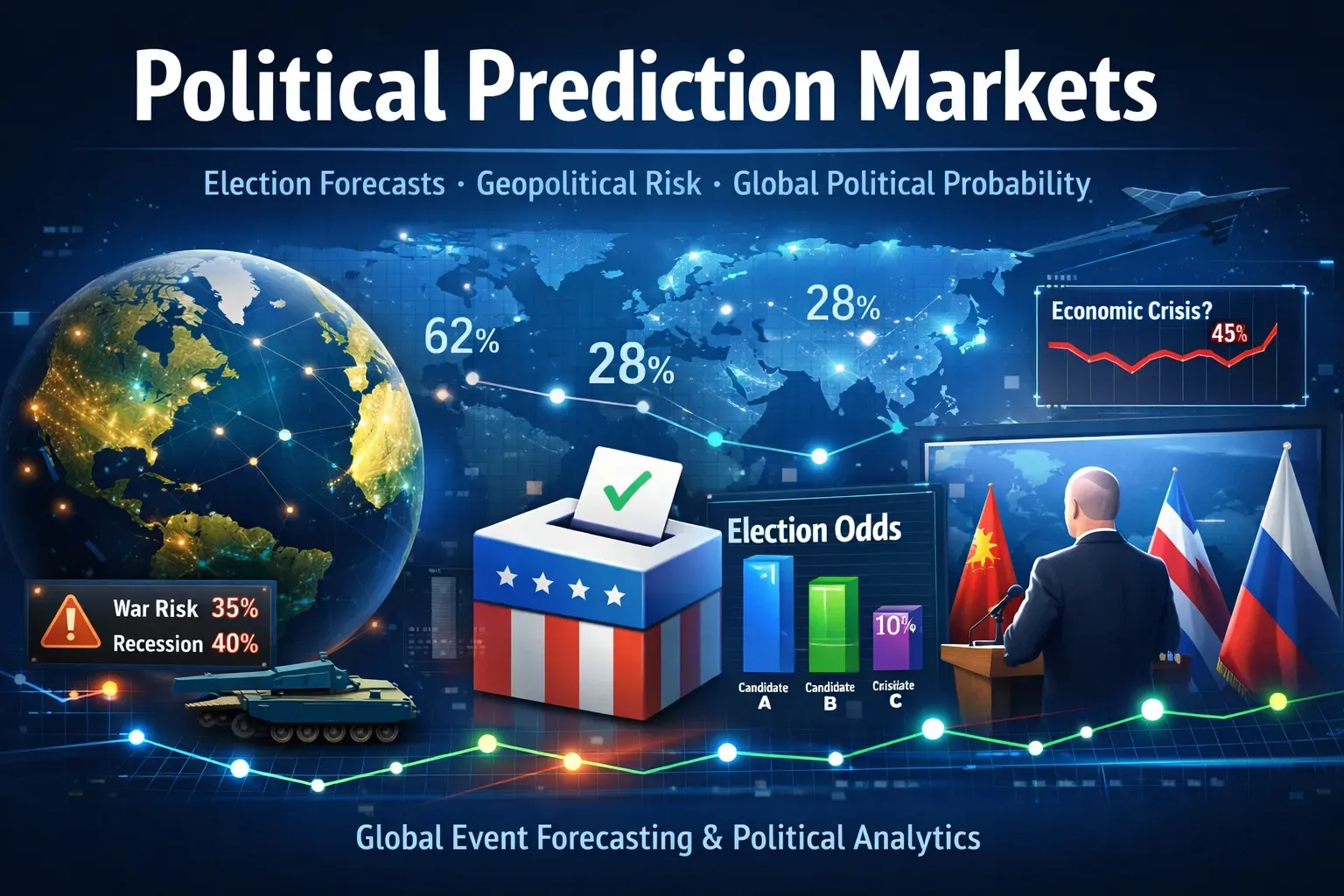
Prediction markets can complement polling, expert models, and news analysis when political outcomes remain uncertain.
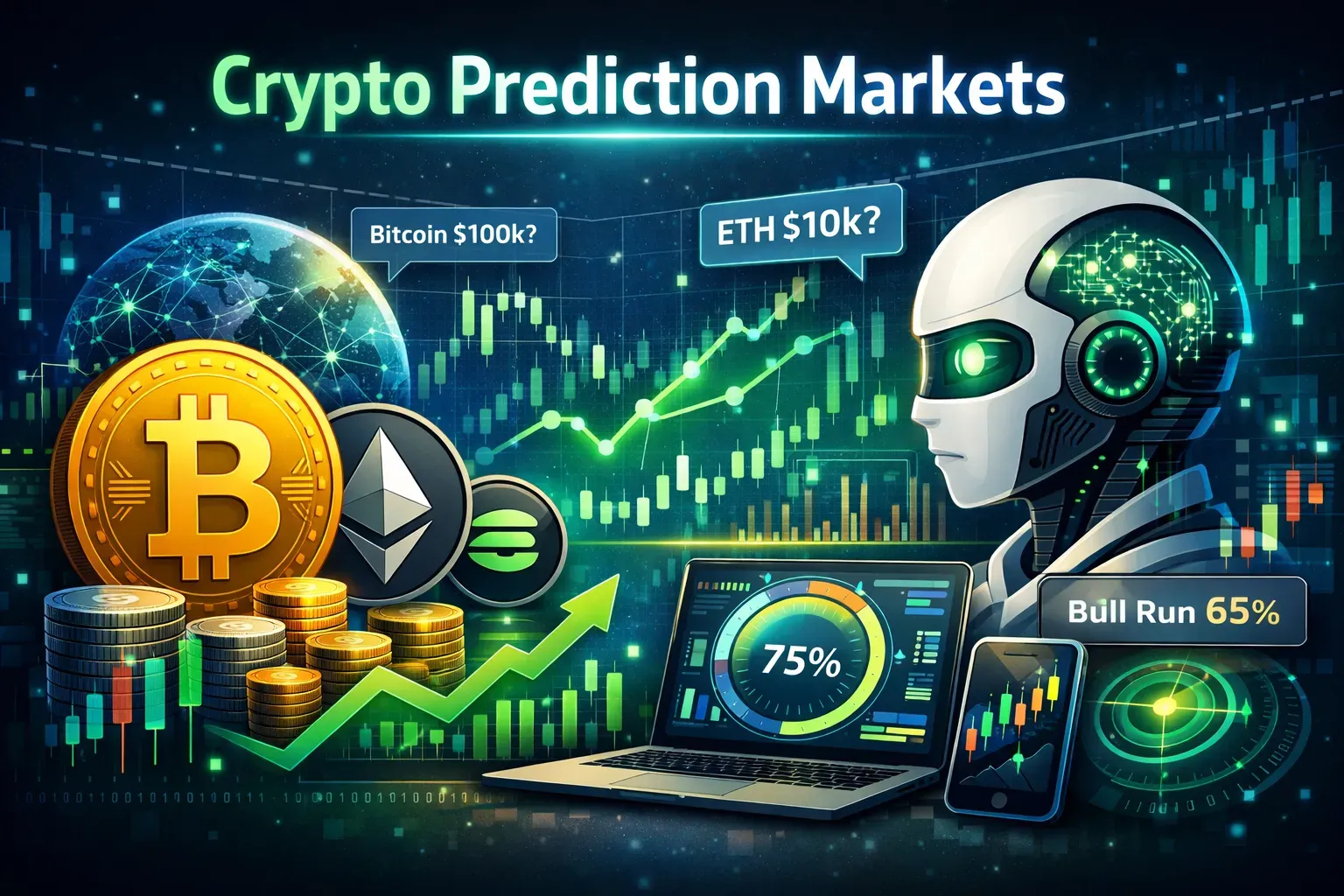
Long-range crypto event forecasts work best when they focus on milestones, regulation, adoption, and macro context.
Find event probabilities by topic, country, and time horizon with a clean editorial interface built for discovery.
Prediction markets are rapidly becoming one of the most powerful tools for forecasting the future. From World Cup outcomes and sports tournaments to political elections, technology releases, and economic developments, prediction markets transform collective intelligence into measurable probabilities.
Our platform allows users to forecast any event in the world using data-driven insights, market sentiment, statistical models, and probability analysis. Whether you want to analyze World Cup prediction markets, evaluate Polymarket forecasts, or explore future event probabilities, this page provides a complete overview of how modern event forecasting platforms work.
Prediction markets are market-based forecasting systems where participants estimate the probability of future outcomes. Instead of relying on a single expert or model, these markets aggregate information from many participants to produce highly accurate forecasts.
Each outcome in a prediction market is represented as a tradable probability contract. The price of the contract reflects the market's collective estimate of the probability of that event occurring.
For example:
| Event | Market Price | Implied Probability |
|---|---|---|
| Team A wins World Cup | 0.45 | 45% |
| Team B wins World Cup | 0.32 | 32% |
| Team C wins World Cup | 0.18 | 18% |
This market structure makes prediction markets one of the most accurate forecasting mechanisms available today.
Popular platforms like Polymarket demonstrate how markets can forecast everything from sports events to political elections.
Prediction markets outperform many traditional forecasting methods because they combine:
Research has repeatedly shown that market-based probability forecasts often outperform expert predictions and traditional polls.
Key advantages include:
| Feature | Benefit |
|---|---|
| Market-driven probabilities | Reflect real-time information |
| Decentralized forecasting | Multiple perspectives improve accuracy |
| Financial incentives | Encourage honest predictions |
| Continuous updates | Markets adjust instantly to new data |
Because of these advantages, prediction markets are now widely used to forecast:
One of the most popular applications of prediction markets is sports forecasting, especially for major events like the FIFA World Cup.
A World Cup prediction market allows users to estimate:
| Team | Market Probability | Model Probability |
|---|---|---|
| Brazil | 22% | 21.5% |
| France | 18% | 17.8% |
| England | 14% | 15.2% |
| Argentina | 13% | 12.6% |
| Germany | 9% | 10.3% |
These forecasts are produced using football probability models, expected goals analysis, and statistical simulations.
Modern sports forecasting models use advanced analytics to generate accurate tournament predictions.
Important inputs include:
Typical World Cup prediction model analysis involves running thousands of simulations.
Example simulation process:
| Simulation Runs | Purpose |
|---|---|
| 10,000 | Baseline predictions |
| 50,000 | Stable probability estimates |
| 100,000+ | High-confidence forecasts |
This data-driven approach produces the most reliable World Cup probability forecast.
Many users compare prediction markets vs sportsbook odds.
Although both express probabilities, they function differently.
| Feature | Prediction Markets | Betting Odds |
|---|---|---|
| Probability source | Crowd forecasting | Bookmaker pricing |
| Market updates | Continuous | Controlled by sportsbook |
| Information source | Collective intelligence | Risk management models |
| Transparency | High | Limited |
Because of this structure, prediction markets often provide more transparent probability signals.
Polymarket is one of the most recognized platforms for event forecasting. It allows users to estimate probabilities for global events including sports, politics, finance, and technology.
Typical Polymarket markets include:
| Market Price | Implied Probability |
|---|---|
| $0.70 | 70% |
| $0.50 | 50% |
| $0.20 | 20% |
This simple mechanism makes Polymarket probability analysis easy to interpret.
Successful forecasting in prediction markets requires understanding both data analysis and market psychology.
Common strategies include:
Using better information than the market.
Applying probability models, simulations, and historical analysis.
Identifying mispriced probabilities.
Entering markets when new information appears.
While sports forecasting is popular, prediction markets can estimate probabilities for any future event.
Examples include:
| Category | Forecast Examples |
|---|---|
| Sports | World Cup winners, Olympic medals |
| Politics | Election outcomes |
| Technology | Product launches |
| Finance | Market indicators |
| Entertainment | Award winners |
This makes prediction markets a powerful event forecasting platform.
Prediction markets are growing globally, especially in regions with strong interest in sports analytics and forecasting technology.
Australia has an active sports analytics community focused on:
Australian users frequently analyze sports prediction markets for tournaments such as the FIFA World Cup and major international competitions.
Japan has a strong culture of statistical modeling and data science, which translates well into prediction markets.
Popular areas include:
South Korea has a rapidly growing analytics ecosystem focused on:
Prediction markets Korea communities frequently analyze global sports events and esports competitions.
Indonesia has one of the largest online communities interested in:
Football remains the most popular forecasting category in prediction markets Indonesia.
New Zealand's sports analytics community focuses heavily on probability forecasting for rugby, cricket, and football tournaments.
Prediction markets New Zealand users often analyze international sports events using statistical models.
Prediction markets continuously track future global events.
Examples include:
| Event Type | Example Forecast |
|---|---|
| Sports | Upcoming World Cup tournaments |
| Politics | National elections |
| Technology | Major product releases |
| Economy | Interest rate changes |
Forecasting platforms provide probability updates in real time as new information becomes available.
Many forecasting platforms include tools that help users convert market prices into probabilities.
Formula:
Probability (%) = Market Price × 100
Example:
| Market Price | Probability |
|---|---|
| 0.65 | 65% |
| 0.40 | 40% |
| 0.15 | 15% |
This simple calculation allows users to interpret prediction market probabilities instantly.
A typical workflow looks like this:
Combining data models with market intelligence produces the most accurate forecasts.
Prediction markets are expected to grow significantly as more industries adopt probability-based decision making.
Key future trends include:
These developments will make prediction markets one of the most important forecasting tools in the digital economy.
A prediction market is a platform where users forecast future events by trading probability contracts that represent the likelihood of outcomes.
Yes. Research shows that prediction markets often outperform traditional forecasts and expert predictions because they aggregate information from many participants.
The market price of an outcome contract reflects its implied probability. For example, a price of $0.60 represents a 60% probability.
Prediction markets can forecast almost anything, including:
Yes. Sports forecasting—especially World Cup prediction markets and football probability models—is one of the largest categories in event forecasting.
Prediction markets represent the future of forecasting. By combining crowd intelligence, statistical models, and market incentives, they create highly accurate probability estimates for real-world events.
Whether you want to analyze World Cup probability forecasts, upcoming sports events, political predictions, or global trends, prediction markets provide a powerful framework for understanding the future.
As forecasting technology continues to evolve, platforms that integrate data-driven models, real-time market signals, and global participation will define the next generation of event prediction systems.